
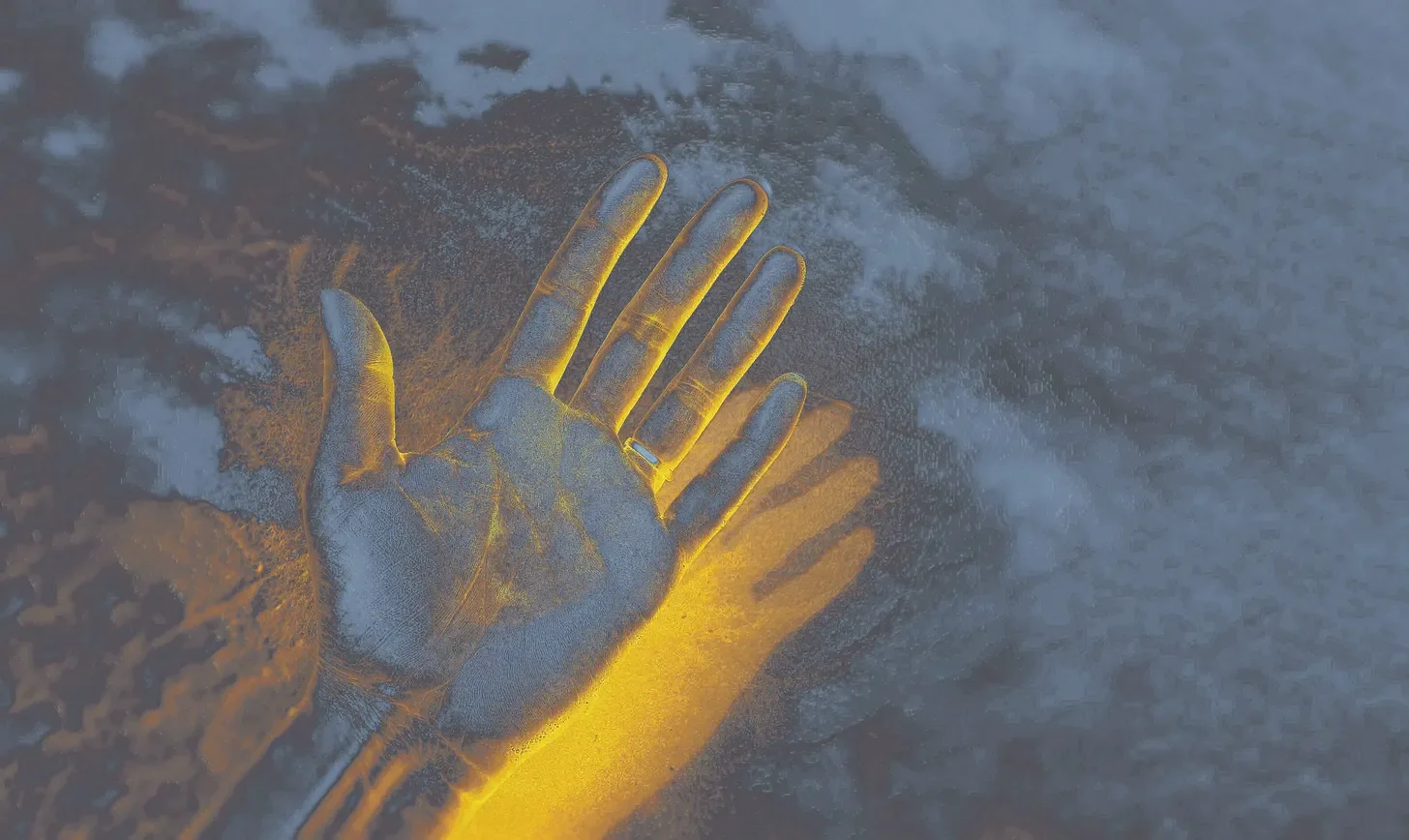
Just when you thought the world was saturated with every possible form of intelligence, artificial, emotional, machine, and otherwise—there’s a new release.
Introducing, in full capital glory: H.I. Hand Intelligence.
While other systems require vast data centres, government-sanctioned harvesting of citizens’ data, and an energy demand that has quietly undone the climate progress we managed to make, H.I. runs on something far from this senselessness: a living body.
This intelligence does not scale with wealth or improve with subscription tiers. Its ultra-premium, pro-max features are for everyone. Learns through friction, pressure, resistance. Restores focus. And most importantly, gives you something to do.
It is not trained on you. It is trained by you.
Hold on.
This is getting pretty cheesy.
Agree.
But this A.I. thing is getting out of hand.
A touchy topic
I have always felt particularly connected to the natural environment; it’s also probably why my first job back in 2012 was at Greenpeace in New Delhi. I couldn’t think of a more important task than making posters calling on the government to ban coal-mining in some of the oldest forests in Central India. And so, it’s easy for me to sympathise with the climate protestors who superglue their hands on streets, and those that sneak cans of soup into a museum. I don’t think it helps the cause, but I can understand that desperation.
I have always thought it stemmed from a short hippie-phase when I was 18, in a sort of liberal university in India. I remember telling an activist working at Amnesty International (before the government shut them down, just like Greenpeace, for being “anti-national”): “If you really care about human rights, you need to be an environmentalist first.” That’s just how a twenty-something speaks, with a blissfully ignorant clarity. At 35 now, I still believe there is some truth in that statement; I just wouldn’t say it like that.
Lately, I have been thinking that this feeling for die Klima (the climate) could be much more deep-rooted. I am the granddaughter of a farming family from Haryana. My father, now retired and unable to bear city life, is constructing a mud-hut in the village and tending to a big orchard. On my mother’s side, my uncle, is an avid bird-watcher, always prone to pressing the car brake all of a sudden only to point out a tiny passing bird often with a longish name like ‘the-Indian-blue-chested-rainbow-flycatcher.’
I have this vivid memory of visiting the farmhouse of my grandmother’s brother, who was a Minister for the Environment, in Rajasthan. I was 7 years old, and remember being taken toward these scary howls and loud roaring sounds. In the shade of a huge banyan tree, I saw them—lions, tigers, and a black leopard, pacing in their cages. Buckets of water were being thrown on husk walls, and fans were blowing air around to keep them from the 40-plus-degree heat. The government had banned the use of animals in circuses, and they had been confiscated and temporarily housed there before being relocated to a sanctuary. So yes, I come from a family that has always been—spoken in sincere boomer-lingo—true nature lovers.
This upbringing has likely shaped my belief that regulating our dependency on fossil fuels is one of the most important things to tackle collectively as a society. Climate change should, in fact, be especially concerning for those who keep bringing up the “migration problem”, especially right before elections.
We were, perhaps, still on track—until 2020. Then the world somersaulted. A world in total disarray was hastily put back in order using technology: social life was distanced, hands were sanitised, and what remained of human contact was routed through APIs, through interfaced actions, through a web of exchanges.
What has followed since is an acceleration in the implementation of a vision that replaces the natural with the virtual—not only in physical experience, but also in language and cognition, thereby reshaping the ways in which we engage with the world.
source unknown
Everybody put your hands-up-in-despair !
Vegans are lucky, because when they go anti-dairy, they still have options (and that cashew cheesecake wasn’t that bad). But try going anti-smartphone or anti–social media, and you’re forced to make your case on the very platforms you’re trying to escape.
When everything seems to be taking place in this new environment, leaving it would feel like a kind of social suicide because it’s such a symbiotic relationship.
Think of the evolution of social media: from awkward filter photos and Paulo Coelho quotes to becoming officially the front-facing façade of brands and businesses, to creating a world of ever more unhinged political posturing. It’s easy, to say the algorithm sucks (and it does, to a huge degree)—but is it all just bad? Where do you draw the line? Both H&M and a young, nonchalant girl from India selling her tailored garments via reels have seen success.
We, maybe unwittingly, also did this by migrating en masse and gentrifying a lived experience that began with kids having fun, then drew professionals and celebrities, until shops opened, paywalls emerged, and it became the equivalent of a shopping mall, with us on display.
Meanwhile, the backend quietly powered everything—storing data, adapting in real time, processing logic, and scaling seamlessly. The infrastructure plays a huge role in shaping the interactions within it, and any architecture student can tell you the implication a layout of a city has on the social life of its citizens. So the companies have to be held responsible for the code. But what are we to do when code writes and decides for itself? When agents malfunction and robots falter? There are other questions too. How, for instance, does one speak of privilege to genetically designed babies?
These days it’s impossible even for a tech-nerd to have total oversight of how things are developing. It’s too much and it’s happening too fast. There is plenty of hype—some justified, but a lot of it is simply blind, unevaluated faith. All apps & businesses eagerly, without understanding, without consequence labelling themselves A.I. It’s like when air conditioners became a bit cheaper in India and all the roadside highway restaurants in India suddenly added “A/C” before their names: Air-Conditioned Radhe Shaam Dining Hall Hotel & Restaurant. But here, at least people quite literally knew what they were getting into and it was chill.
Overnight, we have robots dancing, political enemies making out in deepfakes, and AI Jesus delivering sermons. As a child I used to dream that by the time I grew up, science would have advanced enough for us to speak with animals. So I am genuinely surprised that it's only through AI, we have begun to unlock what sperm whales say to one another. We are a long way from communicating with them, but when we do, I secretly hope their first translated message to us is something as lucid as ‘leave me alone’.
And I can’t shake the feeling that by the time ‘tech gets better’ very few of those whales will remain in the wild to hear us, or to answer. Of course, some preppy tech-bro will jump in to say, “relax yaar, we’ll just engineer life.”
Within just a few years, AI has insinuated itself into our lives, and we have allowed it to take over not only menial tasks but aspects of our thinking as well.
Previous technological advances took time to be implemented, allowing for more gradual transitions and giving younger generations the chance to adapt. Now, however, this shift appears to be undermining their prospects. Last year, it was entry-level jobs—the very roles where young people have their first work experience. If we fail to preserve a space for them, we risk leaving a vital portion of the population with nowhere to begin. And this promise that ‘new jobs will emerge’ offers little reassurance to a generation that needs opportunities now.
Already, this year, AI agents are beginning to take on professional roles. Here in Berlin, I know many architects, designers, and engineers who have been laid off and have struggled to find work over the past two years. And don’t these so-called ‘new jobs,’ focused on training and correcting AI systems, simply replace one form of repetition, something AI was meant to eliminate, with another?”
With hope for the future fading, I see how youth culture retreats into recycled pasts, nostalgia packaged and sold as comfort. At the same time, there is also a commodification of catastrophe, polishing apocalypse into a marketable aesthetic. Even our sense of doom gets sexy-ified and sold back to us.
Too cool to be a tool
I have always been critical of my tools—from yelling at the ruler, cursing the hammer, to smacking the television. Call me anti-progress, a Luddite, a traditionalist, or too conservative, but even those labels deserve a second look. Having a say in how a technology progresses is not resistance; it is participation. It is a contribution toward a more constructive, more democratic direction, especially when the tool decides it no longer needs us to wield it.
In the most extreme expression of the deterministic view, human beings become little more than 'the sex organs of the machine world,' as McLuhan memorably wrote in the 'Gadget Lover' chapter of Understanding Media. Our essential role is to produce ever more sophisticated tools—to 'fecundate' machines as bees fecundate plants—until technology has developed the capacity to reproduce itself on its own. At that point, we become dispensable. A tool once extended the hand. Now it replaces it.
There is this idea that machines taking over tasks from us ought to liberate us to do greater things. But as Silicon Valley is eagerly awaiting its new messiah - AGI. - it no longer seems like a replacement of repetitive or dull work but awfully like human obsolescence.
A story is being sold—how, like a new god,
it will free humanity from the shackles of work, disease, and sin,
take it a notch higher,
liberate us from our bodies through brain uploads,
add the ethical note
so we are no longer this organic material that “guzzles” energy, reducing the pressures on the natural environment.
As if servers were running on pixie dust.
All this equating of AGI with some kind of gnostic salvation, equating transhumanism with moksha and comparing consciousness to the black box of how AI works, needs to stop. Find your own narrative guys or ask Chatgpt to create one. Stop stealing our ideas. Oh, but that’s your business model!
Fate protects those who defend lost things from the terrible applause of the stupid - Don Colacho - Nicolás Gómez Dávila
I had a dream, and it’s definitely not like this
Have you seen this “Dream Recorder”? One of those “OMG, so cool—at first sight—products—imma double tap”—uh, but actually, when you really think about it, it’s a very stupid product. In most cases, it’s just an AutoCAD, or now an AI image of a supposed product. Hyped for aesthetics and superficial concepts, it quickly goes viral on Instagram, gets reposted, and you know how that goes.
Check it here: Dream Recorder. Or have my version: it’s an ai-video generator in a plastic box.
As an artist, I rely on my dreaming state immensely. I rely on rest, on the ideation that emerges especially during these states of non-doing. All the information I process, churning together with my experiences, my memories, the cross-connections generated within them, and the physical experiences of my body throughout the day, find their way into my dreams. At least, this is my understanding. There are, of course, many other fascinating theories as well.
Like this one I heard growing up in India: at night, when people fall asleep their souls leave their bodies, traveling through other realms, across time zones, meeting other people—where all things are possible. When we return, we remember fragments of what happened.
And then comes this Dream Recorder that asks of you “wake up, speak your dream aloud, and watch it come to life as a dreamscape in the aesthetic of your choice.” But what it really demands is “wake up & let me crush your dreams”.
Dreams are not data stored on any server. Your mind holds a better image of it, and this device will only empty you of your capacity to dream. To dream!
Imagination is an essential technique of acquiring knowledge, and understanding reality. If I outsource this, what will be left of me.
This isn’t imagination set free. It is imagination handed over.
Drawing Hands, lithograph, M. C. Escher, 1948
The machine breeds its own backlash
These days, teachers in high schools are being told not to assign lengthy texts because students can’t read as much anymore. I saw a lecture from the 90s where students were required to know Greek and Latin before taking up a philosophy course. When someone points out that there is a decline in our abilities, the response is to share memes about how Plato found reading and writing unnatural, signalling that mediums of information keep changing. But they never mention that Plato believed reading and writing to be inferior substitutes for true understanding and memory.
And all the same, every time an AI thinks for you is an opportunity you didn’t take to understand something for yourself.. The auto-complete in emails felt so convenient at first - wow, I can write so much better now. But no, I can’t. I’m not writing. Each time I start, it finishes. I never learn. Learning requires remembering and recalling and if something is always there to do it for me, the muscle never forms. After a while, the chain of emails starts to feel distant, hollow. How will I sound when I meet that person in reality? Almost certainly nothing like the person who wrote those messages. And most likely, neither will they.
The brain's elasticity has immense capacity, yet so much of our daily engagement—mediated through technology, is quietly shrinking into pattern recognition and symbolic shortcuts. This was supposed to be the future. Instead, we find ourselves behaving like medieval mobs, our political priorities revealing that we are edging dangerously close to being comfortable with witch-burning again.
With cleaning robots already being rolled out, we are beginning to resemble the humans of Pixar’s WALL-E—soft, sedentary, alleviated from every friction. Every task removed from the body also removes contact, with material, with effort, with purpose. I don’t mean to romanticise laborious work; I only ask that we preserve a level of technological convenience that still allows us to use what evolution gave us—brains and limbs together—and that it serves everyone fairly.
Which brings me to a question I keep returning to: how much of myself do I lose when I use this technology? Not just whether something is more convenient, but what it costs further down the line? What does it make harder? What does it quietly take away? Food delivery services have created chains of exploitative labor, carried out mostly by migrants with little protection. It has also replaced physical errands and those small daily negotiations people made with each other and left us with a whole lot of trash!
My biggest fear is not that we are becoming less capable—though the Reverse Flynn Effect suggests we are. My fear is that soon very few will be able to notice the difference. That, and the fact that the dancing robots will soon be holding guns.
Even as I dwell on these doomsday scenarios, I carry a gut-feeling that the pendulum will swing. It always does. Every extreme eventually finds its counter. Human nature has a way of reasserting what was suppressed.
Mary Harrington, in an interview about Feminism Against Progress, says: “There’ll be a backlash, because every time we try to abolish some aspect of ourselves in those ways, the eventual result is that that thing, that aspect of normative human nature—comes more clearly into focus. And this is really, I think, the core of my hopefulness about the situation.”
Clementine Keith Roach, terracotta, 2018
I hope the future sets us back by many years and that is still progress
Since we have already begun surrendering aspects of our cognition to the development of AI, it seems only natural that it would come for the hands next. Haptics and spatial reasoning remain among the most challenging frontiers for AI—arguably some of the last barriers before machines approach something like human-level general intelligence. And they are working tirelessly to get there.
Before intelligence became something to package, scale, and sell, it was something to practice. Richard Sennett, in The Craftsman, describes handwork as a slow dialogue between maker and material. I recognise this from my own studio. Working with my hands, I am not simply producing an object; I am entering into a relationship with time, with my thoughts and through my body.
As someone who also worked in digital design, I have tried to be more open and see how this kind of thinking doesn’t belong exclusively to the potter or carpenter. I would argue it is equally present, or ought to be, in the design of digital systems and products. The difference lies not in the nature of the thinking but in what the tools and their environment permit. Digital tools remove the constraint of the body, and with it, a natural governor on quantity. The hand can only make so much, and perhaps there is something in that limit we haven't learned to value. The screen has no such limit, tools speed-up everything and that limitlessness has consequences we don’t clearly understand or don’t reckon with.
This slow emergence, where form arrives through repetition, error, adjustment, refinement—is what Sennett calls a "mental bond" between doing and thinking. And it points toward something larger: embodied cognition, the understanding that intelligence is not confined to the brain alone. It is distributed across the body, shaped by action, refined through touch. The hand does not merely execute commands—it participates in thinking, and in doing so, educates the mind. Which incidentally, is one of the reasons why the whole brain-upload transhumanism project is so confused about what a human being actually is.
There is also an ethics embedded in this. To work with your hand is to take responsibility—for the quality of the object, for the care invested in it, for the consequences of making. Unlike automated systems, where action can be endlessly distanced from its outcomes, handwork stays answerable. It is a mode of attention—one that binds thought to action, and action to accountability.
But it’s so slow, I hear. And I want to ask: why are we in such a rush? The speed of everything is giving the whole world anxiety.
We are beings of time and to sense its passage is to be human.
Let’s Hold Hands
(and be cringe)
As humans we are always seeking consensus, within groups, within ourselves, a sense of belonging within something that endures. Yet the world never stays still. To navigate it, we must adapt. But are we infinitely malleable? When change comes too fast, what becomes of the “us” we once knew? Sometimes the ways we adjust feel alien, even unacceptable, as if survival demands we keep trading pieces of ourselves with ‘tokens’ to access the next world.
But human nature is not simply a given to be overcome. It is a source of value, the ground from which any notion of better or worse derives. Once you dissolve that ground, by what standard do you make your species whatever you wish it to be? Even granting constant transformation, some nature must be operative as the measure. Otherwise the word "evolving" becomes empty.
And when we can see clearly the repercussions of these technologies, do we simply watch from our existential balconies, shrug, and muse that even the sun will one day burn out?
Human nature will be the last part of Nature to surrender to Man… The battle will indeed be won. But who, precisely, will have won it? C.S. Lewis, The Abolition of Man
For my part, it has begun to feel complacent to claim that “every generation thinks it’s living through its own apocalypse,” when, in truth, much has worsened—even as global indicators like health, poverty, and life expectancy continue to improve. If nothing else convinces you, let the state of our natural world speak for itself. I know this argument will not reach those who prefer to understand the world as a simulation, or as maya—such views permit a certain distance from it. But I would wager this: even a brain fed the most perfect simulations—every texture, every resistance, every consequence, it would still perish. An essential matter escapes the code.
Our bodies connect us to the largest operating system there is: lifeitself. And our consciousness may not be fully reducible to the brain alone. Our hands are our primary interface with reality; touch is how we first learned the world is real. What the mind holds in theory, the body expands through action. This is how intelligence truly forms: rules bend in practice, definitions soften in contact with others, and rigidity gives way to something alive.
_
I have been reading the Mahabharata, Carole Satyamurti's verse retelling and have arrived, as anyone reading it eventually does, at the Bhagavad Gita. Krishna is advising Arjuna on dharma—his duty to act, because non-action weakens perception itself. I find something profound in this, for everything I have been trying to say here. Action is not just moral. It is epistemological. I take some poetic liberty and further my case though Krishna’s argument. To act physically, with the body, with the hand, is to know most deeply, to withdraw from doing is to understand less, perceive less, and care less.
Hand intelligence is embodied and answerable. It is slow, but attentive. In a world moving too fast to think, this is precisely what intelligence needs to look like.
_
Latika Nehra
Berlin, 28.03.2026
ending notes:
I am not suggesting that we all take up ceramics and start making our own pasta. I am critical of the implications of these technologies, even as I use them myself—visibly, imperfectly, and without apology.
What I am arguing for is that we invest far more in the embodied intelligence we already possess. The kind of intelligence that this technology does not have, and that we risk losing through our uncritical embrace of it. This is the intelligence that deepens through material engagement, keeps us responsive to the natural world, and may yet offer solutions to problems no algorithm is equipped to solve.
A lot of my writing is edited by my husband, and although he doesn’t agree with everything I have to say, he does help me to really think about what I am trying to say. He doesn’t provide me with proper corrections, in fact leaves me with more questions. When I looked for some grammar and sentences correction, I used Claude AI. My studio-mate who is American helped me achieve the last more sensible version for this text.
In 2023, I wrote a small-ish write up on my website observing similar ideas and themes, it is nice to see a continuation in retrospect: The Gr8 migration